Public Schools

Schools were supposed to protect you. They didn't. We hold them accountable.

Do you have a case?

Take a free quiz written by an experienced attorney. You can't decide what's best for you until you know if you have a case and what it might be worth.

Do you have a case?

Take a free quiz written by an experienced attorney. You can't decide what's best for you until you know if you have a case and what it might be worth.

Schools were supposed to protect you. They didn't. We hold them accountable.

The Problem No One Wants to Talk About


Have you ever wondered why—with all the attention, all the lawsuits, and all the legislation—we still haven't ended sexual abuse in public schools? You open up the news every day and see yet another teacher abused yet another child.
A lot of people think it's hopeless. But it's not.


The truth is simpler—and it is its own scandal: For decades, schools have framed the threat incorrectly. They've relied on background checks, "red flags," and waiting for someone to report abuse. Then they act shocked, investigate, fire the perpetrator, settle, and repeat.


That approach was never prevention. It was mop-up. And it guaranteed that dozens of children would be harmed before anyone acted—if anyone acted at all.Why Schools Keep Failing
A school is a structure of people, places, and pathways where non-parental adults have recurring access to children while parents are absent.


Those pathways aren't rare. They're normal school operations:

  • Pull-outs and closed-door sessions

  • One-on-one tutoring, mentoring, and "special help"

  • After-hours access to classrooms, gyms, and locker rooms

  • Transportation to games, events, and competitions

  • Private messaging through school platforms or personal devices


Abusers know this. Research shows that roughly 75% of youth-serving organization perpetrators admitted—or refused to deny—that they sought out positions in these organizations specifically to gain access to children. They don't look dangerous. They often look like the most dedicated teacher in the building. Teacher of the Year. Coach everyone loves. The adult who "really connects with kids."


The key insight most people miss: Supervision in a school isn't primarily about watching individual people. It's about governing the pathways. It's deciding what kinds of access are allowed, under what conditions, with what visibility, and with what documentation.


When a school fails to govern those pathways, it creates the conditions in which abuse becomes possible—and predictable.What Happened Was Not Your Fault


If you were abused by a teacher, coach, staff member, bus driver, or another student, you did not cause it and you could not have stopped it.


The adults in charge had one job: keep you safe. The school had policies it should have followed. There were warning signs someone should have seen. There were pathways that should have been closed. The burden to prevent what happened was never yours.
If you've carried shame, self-blame, or the weight of wondering whether anyone would believe you—that weight was never yours to carry. The failure belonged to the institution that was supposed to protect you.How We Build Your Case
Most public school abuse cases are negligence cases. That means proving the abuse happened is only part of the legal work. We must also prove the school failed in its duty to protect you.


Our legal approach focuses on how the institution made the abuse possible:
Failure to Govern Pathways

  • Did the school allow unsupervised one-on-one access between staff and students?

  • Were there controls on private communications, after-hours contact, or off-campus transportation?

  • Could an adult use the school's own systems to isolate a student repeatedly with little oversight?


Failure to Implement Prevention Policies

  • Did the school have a written sexual abuse prevention policy?

  • Was it actually followed, documented, and enforced?

  • Were staff trained to recognize grooming behaviors and boundary violations?


Failure to Respond to Warning Signs

  • Were there boundary violations—favoritism, excessive personal attention, inappropriate comments—that went unaddressed?

  • Did anyone raise concerns that were minimized or buried?


Failure to Report

  • Did the school report suspected abuse to law enforcement or child protective services as required by law?

  • Or did it delay, minimize, or handle it "internally"?


These theories of liability are additive. Your case may involve one or several. And importantly: most cases do not have proof that the abuser had prior victims. That's okay. Institutional liability doesn't depend on proving the school knew this specific person was dangerous. It depends on proving the school failed to create and maintain systems that would have made any predator's conduct structurally difficult.Your Legal Rights and Options
Your rights depend on where the abuse happened, when it occurred, and how old you were. Public school cases involve additional complexity because school districts are government entities.


Key considerations include:

  • Shorter deadlines: Many states require a "notice of claim" before suing a public entity, sometimes within 6 months to 2 years of the incident.

  • Extended statutes of limitations: Many states have extended or eliminated deadlines for childhood sexual abuse, recognizing that survivors often don't come forward for years or decades.

  • Discovery rules: Some states start the clock when you realized the abuse caused you harm—not when the abuse occurred.

  • Title IX claims: Federal civil rights law may apply when schools are deliberately indifferent to sexual harassment or abuse.


These rules are complicated and vary by state. Part of our role is to analyze them and protect your deadlines so your rights are preserved. What to Expect When You Contact Us
Reaching out to a law firm can feel overwhelming—especially when you're not sure you're ready to take legal action.
Here's what happens when you contact us:

  • We won't ask you to relive everything on the first call. We'll listen to whatever you're comfortable sharing.

  • We'll answer your questions about the legal process, your options, and any deadlines that may apply.

  • There's no pressure. Speaking with us doesn't commit you to anything.

  • Everything is confidential. Attorney-client privilege protects our conversation from the moment it begins.


You are the hero of this story—not us. You survived something the school should have prevented. Our role is to be the guide: to explain the terrain, protect your rights, and walk beside you through a process that can feel confusing and intimidating.
If you choose to move forward, we take on the legal burden so you don't carry it alone. If you choose not to, your decision will be respected. Taking the First Step
The school system may have treated you as a problem to be managed, a story to be buried, or a threat to someone's reputation. At our firm, you are none of those things.
You are a person whose safety should have been protected—and whose voice matters now.

  • Call us

  • Fill out our confidential intake form

  • Send us an email

The abuser relied on your silence. You don't have to be silent anymore. (edi

Public Schools

FAQ

Why are private schools particularly vulnerable to sexual predators?

What should an effective sexual abuse prevention policy in a private school include?

What should I do if I suspect abuse is occurring in a private school?

Why is it important to consult with an attorney experienced in private school sexual abuse cases?

How do predators typically operate within private schools?

How can parents spot potential red flags in a private school's approach to child safety?

How can survivors overcome feelings of shame or self-blame when considering legal action?

You Are Not Alone

Even if it happened a long time ago, we can often still find a way to help.

Reach out today for a confidential consultation. No judgment, no pressure,

just understanding and help.

* Your initial consultation is free and confidential.

Latest News & Updates
Predator Tactics

What Are College Policies on Sexual Assault?

Understanding the Long-Term Effects of Sexual Abuse: Emotional, Physical, and Relational Impact

Jeffrey D. Meyer

Over 30 years as a lawyer, Jeffrey D. Meyer is committed to changing the way youth serving organizations address the problem of sexual abuse in a way that deals with it in the way that it actually is, rather than how we imagine it to be.

Dec 29, 2025

5

min read

Predator Tactics

What Are College Policies on Sexual Assault?

Understanding the Long-Term Effects of Sexual Abuse: Emotional, Physical, and Relational Impact

Jeffrey D. Meyer

Over 30 years as a lawyer, Jeffrey D. Meyer is committed to changing the way youth serving organizations address the problem of sexual abuse in a way that deals with it in the way that it actually is, rather than how we imagine it to be.

Dec 29, 2025

5

min read

Institutional Abuse

Comprehensive Guide to Sexual Assault Investigation Procedures

Understanding the Long-Term Effects of Sexual Abuse: Emotional, Physical, and Relational Impact

Jeffrey D. Meyer

Over 30 years as a lawyer, Jeffrey D. Meyer is committed to changing the way youth serving organizations address the problem of sexual abuse in a way that deals with it in the way that it actually is, rather than how we imagine it to be.

Dec 29, 2025

6

min read

Institutional Abuse

Comprehensive Guide to Sexual Assault Investigation Procedures

Understanding the Long-Term Effects of Sexual Abuse: Emotional, Physical, and Relational Impact

Jeffrey D. Meyer

Over 30 years as a lawyer, Jeffrey D. Meyer is committed to changing the way youth serving organizations address the problem of sexual abuse in a way that deals with it in the way that it actually is, rather than how we imagine it to be.

Dec 29, 2025

6

min read

Institutional Abuse

The Long-Term Effects of Sexual Abuse on Survivors

Understanding the Long-Term Effects of Sexual Abuse: Emotional, Physical, and Relational Impact

Jeffrey D. Meyer

Over 30 years as a lawyer, Jeffrey D. Meyer is committed to changing the way youth serving organizations address the problem of sexual abuse in a way that deals with it in the way that it actually is, rather than how we imagine it to be.

Dec 29, 2025

4

min read

Institutional Abuse

The Long-Term Effects of Sexual Abuse on Survivors

Understanding the Long-Term Effects of Sexual Abuse: Emotional, Physical, and Relational Impact

Jeffrey D. Meyer

Over 30 years as a lawyer, Jeffrey D. Meyer is committed to changing the way youth serving organizations address the problem of sexual abuse in a way that deals with it in the way that it actually is, rather than how we imagine it to be.

Dec 29, 2025

4

min read

Media And Awards For Mark Lanier

Partner Jeff Meyer Wrote The

Book on Ending Child Sex Abuse at

Youth Serving Organizations

Partner Jeff Meyer Wrote The Book on Ending Child Sex Abuse at Youth Serving Organizations

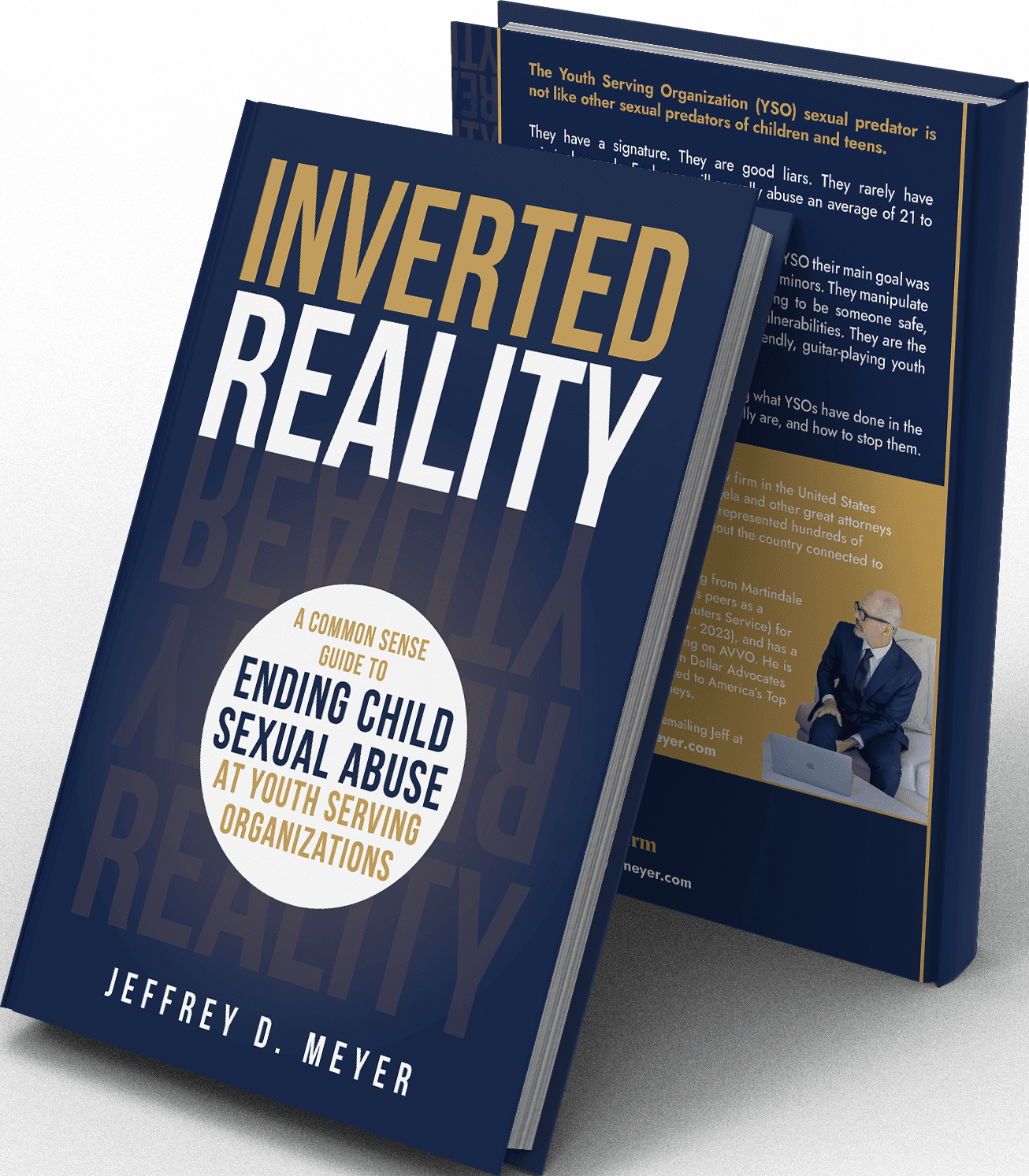
Inverted

Reality

By Jeffrey D. Meyer

A Revolutionary Guide To Protecting Children And Teens From Sexual Abuse At Schools, Religious Organizations, Camps, Sports Teams And Other Youth Serving Organizations. Written by one of our law partners.


#1

Amazon New Release in Personal Injury Law

#1

Amazon New Release inTeen and Young AdultNonfiction on Sexual Abuse

#1

Best Seller in Teen and Young Adult Nonfiction on Sexual Abuse

You deserve a safe path that honors your dignity

and what you’ve lived through.

* Your initial consultation is free and confidential.

All product names, logos, brands and likenesses are the property of their respective owners and may not be owned or affiliated with Lanier Meyer McBride Blair LLP. This website is a Legal Advertisement sponsored by members of Lanier Meyer McBride Blair LLP. Lanier Meyer McBride Blair LLP is responsible for this advertisement and Lanier Meyer McBride Blair LLP offices at 6363 Woodway Drive, Suite 1025, Houston, Texas 77057. Attorney Mark Lanier is licensed in Texas and New York, Attorney Jeff Meyer is licensed in Arizona, Attorney Skip McBride is licensed in Texas and Arkansas, and Attorney Avram Blair is licensed in Texas, Arizona, Pennsylvania and New York. Lanier Meyer McBride Blair LLP’s clients reside in most or all of the states throughout the country and Lanier Meyer McBride Blair LLP has local counsel relationships in other states where such legal representation is required or appropriate. Information provided on this site is for general information only and does not create an attorney-client relationship and should not be taken as legal advice specific to any particular circumstances. The attorney responsible for the content of this website is Avram J. Blair. By using this site, you agree to the Terms of Use and Privacy Policy.

Copyright © 2025 Lanier Meyer McBride Blair LLP.

All Rights Reserved.

All product names, logos, brands and likenesses are the property of their respective owners and may not be owned or affiliated with Lanier Meyer McBride Blair LLP. This website is a Legal Advertisement sponsored by members of Lanier Meyer McBride Blair LLP. Lanier Meyer McBride Blair LLP is responsible for this advertisement and Lanier Meyer McBride Blair LLP offices at 6363 Woodway Drive, Suite 1025, Houston, Texas 77057. Attorney Mark Lanier is licensed in Texas and New York, Attorney Jeff Meyer is licensed in Arizona, Attorney Skip McBride is licensed in Texas and Arkansas, and Attorney Avram Blair is licensed in Texas, Arizona, Pennsylvania and New York. Lanier Meyer McBride Blair LLP’s clients reside in most or all of the states throughout the country and Lanier Meyer McBride Blair LLP has local counsel relationships in other states where such legal representation is required or appropriate. Information provided on this site is for general information only and does not create an attorney-client relationship and should not be taken as legal advice specific to any particular circumstances. The attorney responsible for the content of this website is Avram J. Blair. By using this site, you agree to the Terms of Use and Privacy Policy.

Copyright © 2025 Lanier Meyer McBride Blair LLP.

All Rights Reserved.

All product names, logos, brands and likenesses are the property of their respective owners and may not be owned or affiliated with Lanier Meyer McBride Blair LLP. This website is a Legal Advertisement sponsored by members of Lanier Meyer McBride Blair LLP. Lanier Meyer McBride Blair LLP is responsible for this advertisement and Lanier Meyer McBride Blair LLP offices at 6363 Woodway Drive, Suite 1025, Houston, Texas 77057. Attorney Mark Lanier is licensed in Texas and New York, Attorney Jeff Meyer is licensed in Arizona, Attorney Skip McBride is licensed in Texas and Arkansas, and Attorney Avram Blair is licensed in Texas, Arizona, Pennsylvania and New York. Lanier Meyer McBride Blair LLP’s clients reside in most or all of the states throughout the country and Lanier Meyer McBride Blair LLP has local counsel relationships in other states where such legal representation is required or appropriate. Information provided on this site is for general information only and does not create an attorney-client relationship and should not be taken as legal advice specific to any particular circumstances. The attorney responsible for the content of this website is Avram J. Blair. By using this site, you agree to the Terms of Use and Privacy Policy.

Copyright © 2025 Lanier Meyer McBride Blair LLP.

All Rights Reserved.

All product names, logos, brands and likenesses are the property of their respective owners and may not be owned or affiliated with Lanier Meyer McBride Blair LLP. This website is a Legal Advertisement sponsored by members of Lanier Meyer McBride Blair LLP. Lanier Meyer McBride Blair LLP is responsible for this advertisement and Lanier Meyer McBride Blair LLP offices at 6363 Woodway Drive, Suite 1025, Houston, Texas 77057. Attorney Mark Lanier is licensed in Texas and New York, Attorney Jeff Meyer is licensed in Arizona, Attorney Skip McBride is licensed in Texas and Arkansas, and Attorney Avram Blair is licensed in Texas, Arizona, Pennsylvania and New York. Lanier Meyer McBride Blair LLP’s clients reside in most or all of the states throughout the country and Lanier Meyer McBride Blair LLP has local counsel relationships in other states where such legal representation is required or appropriate. Information provided on this site is for general information only and does not create an attorney-client relationship and should not be taken as legal advice specific to any particular circumstances. The attorney responsible for the content of this website is Avram J. Blair. By using this site, you agree to the Terms of Use and Privacy Policy.

Copyright © 2025 Lanier Meyer McBride Blair LLP.

All Rights Reserved.